The corner has been turned and we really have no idea what to expect ahead of us. The long-awaited year of 2021 could either bring us a step closer to the happy place of “what used to be,” or hurl us further into a dark world of uncertainty. Who knows!?
So, what will we do? I suppose, as those who are children of God, we must do what’s been done since humanity began – look to God, who never changes.
Continue to trust in the One you first trusted. The same God you trusted with your eternal salvation – years, decades, or days ago – is the same God you can trust this very day, in the middle of a global pandemic.
He will guide us through His word and by His Spirit – we have to quiet our souls and listen.
He will provide steadiness and peace when circumstances are raging – we have to keep our focus on the One who is steadfast and unmovable. Not the waves. Not the storm.
He is our hope when the world and even our own minds demand that there is none – we have to rest in His promises. He feeds the sparrow. He clothes the lily with beauty. How much more will He care for you?
Here’s a snapshot of reality in 2021: Your job is uncertain. Your health is uncertain. Gathering with those you love – family, friends, church – is uncertain. Odds of going into a restaurant or grocery store without a mask is uncertain. A return to your life as you once knew it is uncertain. Your next breath? Yep. Uncertain.
So, why on earth would we not reach up and desperately grab hold of the God who is the very essence of certainty? I imagine something like that quickly passed through Peter’s mind as he dropped below the waves while the Master of H2O, hand extended, stood still.
Jesus, help us know how to keep our eyes on You and off the storm. Help us trust and hope in You as we plunge headlong into this year. Guide us through an onslaught of doubt and worry, and bring us to the other side of it, stronger than we’ve ever been. Give us such heavenly peace that those around us notice it, and wonder, “How?”
It was kind of an odd thing for a choir boy. I sang in the school chorus, acted in school plays, and even sang in the Chamber Singers. Yep. I was a glittery-cummerbund-donning, ruffly-shirt-wearing Chamber Singer.
Nonetheless, I also loved sports. I loved watching sports. I loved playing unorganized, pickup games with my friends – baseball, hockey, football, and boxing. Mom doesn’t know about the boxing part. I played church softball and even ran track and field in Junior High and High School.
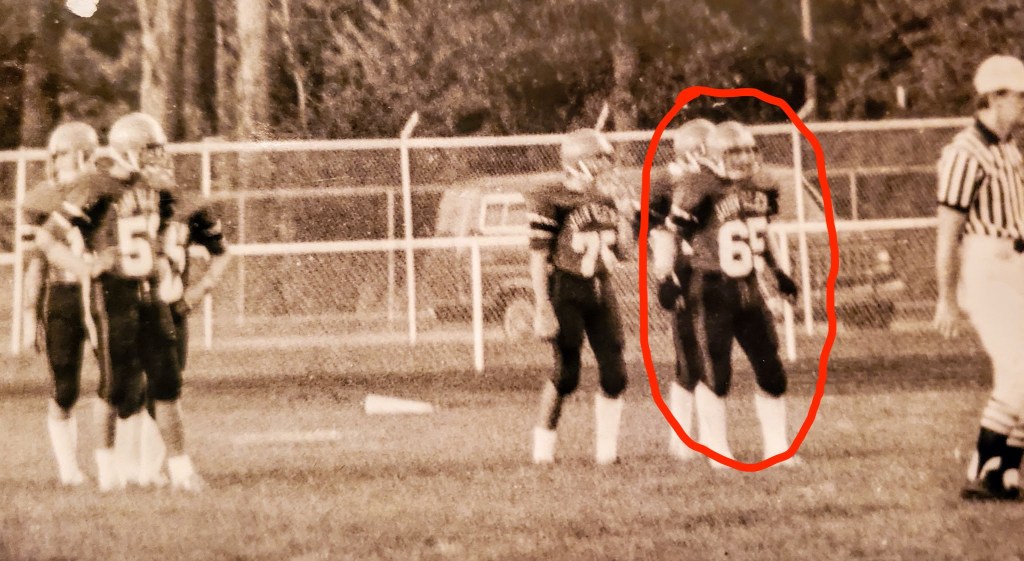
But, for some reason, untalented as I really was athletically, I decided to try out for football and somehow made the team. I was a proud Westland John Glenn Rocket. Unfortunately, I had no clue what I was doing.
I didn’t even know what position I wanted play. Somehow, I believe accidentally, I ended up practicing with the offensive linemen, so I ended up becoming one of those. Later, when I started getting the hang of things, I would also join the ranks of the defensive line (which I loved).
I’ll have to say it was pretty tough, physically. There were plenty of days, especially during two-a-days (two practices per day in the heat of muggy Michigan summers in a dry, dusty field) that I was ready to give up. If it wasn’t for my coaches, I probably would have walked away. They instilled a toughness in me that wasn’t there before.
From day-one our coaches preached, “Never give up.” That has always stuck with me. It’s been engrained in my DNA and has become a part of who I am. It became my battle cry when facing every giant on the other side the line of scrimmage. As a side note, believe it or not, I did get to start on both offense and defense for one whole season! Rudy! Rudy! But then in my senior season I lost all confidence and rode the pine…but that’s a sad story for another day.
Why do I tell you all of this? Along with the never-give-up anthem, there rang another life-altering phrase, just four words that have helped drive me through some of life’s toughest times.
David and Goliaths
I was only five feet nine inches tall and weighed in at a mere 165 pounds, if I had recently eaten a bowl of spaghetti. I often had to line up against guys of Goliath-stature (to me) and my monumental task was to move them out of the way or keep them from destroying our quarterback. When I first started playing, this wasn’t working out very well for me, to put it mildly. But, I would gently turn my helmet back around and try again.
Upon noticing my comical inability to successfully execute my assignments, my coach spoke (okay, yelled…along with an expletive or two) those game-changing words into my life. “Keep your feet moving!” He didn’t say it once. He didn’t say it only to me. He repeated it to all of us, over and over and over.
Whenever he saw any of us with feet planted, toe-to-toe against an imposing force we would hear above all the grunts, groans, and cracking of pads, “Keep your #%$!@ feet moving!” That advice helped me overcome many a defensive foe. It was true! Stand still, get beat. Keep your feet moving, get the job done.
Words to Live By
The helmet and cleats are long gone now, but that one sentence (minus the expletives) still rings loud in my ears every time I experience something hard in life. Whenever I’m tempted to stand still or give in, I hear those words, “Keep your feet moving!”
When I’m worn down from the heat and dust of life’s two-a-days and I’m ready to walk away from it all, “never give up” rises up in my soul and my tired feet begin to move and I press on.
Sound Familiar?
The Apostle Paul shared this sentiment when he wrote to the church at Philippi, “I press on toward the goal to win the prize for which God has called me heavenward in Christ Jesus.” Paul could do this and anything else because he knew it was Christ who strengthened him (Philippians 3:14; 4:13). The author of Hebrews encouraged us to, “Run with perseverance the race marked out for us.”
I have discovered in life there are times when, despite the resolve of my heart, I just cannot muster the strength to move my feet; I cannot find it in myself to run the race or press forward. But, it’s in these despairing moments when I can trust that God will be my refuge and strength, an ever-present help in trouble (Psalms 46:1).
So, when you encounter that immovable giant in your life, remember, keep your feet moving in the strength of Jesus. Trust Him when you don’t feel like you can. He’ll be your strength.
When that trial you’re facing beats you down and wears you out, remember, never give up. Keep your eyes on the prize. Keep pressing on.
With the devastating introduction of COVID-19 and all of its glorious luggage, myriads of vacations, events, and plans have been at best postponed, but more than likely canceled altogether, including that missions trip that you were so excited about.
My church had three incredible trips planned for 2020 and all three have unfortunately been canceled.
Certainly, there is no small amount of disappointment if you are missing out on your trip. But what’s more, think about the hundreds of missionary and national hosts unable to welcome the teams from which they would have received so much help. Not this month. Probably not even this year.
Maybe you hadn’t planned on going on a missions trip this year, but having a heart for global evangelization you’re concerned about the future of cross-cultural ministry. Whatever the case, What are we to do now? How are we supposed to help our global partners in the light of the stifling Coronavirus?
First of all, we can be assured that the events of 2020, most notably COVID-19, have not taken God by surprise. The same God who called each missionary to the field, each national leader to their task, and even each short-term team member to their trip, knew this virus would come and interrupt all of our best laid, prayed-over plans. At the risk of sounding cliché, I emphasize, God. Is. Still. In. Control.
In fact, I have a pretty good feeling (according to God’s track record throughout history) that even greater missions-oriented accomplishments will arise not only in spite of, but as a result of our trips being canceled. But how might that involve us? You have a huge heart for missions but wonder, “What in the world can I do.“
I have a few ideas, alternative activities that any of us can do in the absence of physical, geographical missions trips, that could make an enormous global impact.
First, most missions trips cost each individual a fair chunk of change. In most cases support is raised from multiple sources including family and friends, various fundraising activities, savings, etc. What if, even though you aren’t able to go on a physical trip, you still raised your support? What if, instead of using that money for airfare, insurance, and ground costs, you raised it for the host toward a special project or general need?
For example, if fifteen team members each continued to raise what was their required $2,500 for a canceled trip to Tanzania, and in turn sent it on to Michael Titus for whatever project, that would be a total of $37,500! Even better if non-team members pitched in! I can only imagine all that Michael could accomplish with that kind of gift once he regained consciousness.
Second, and on even a grander scale, what if, during the dates of your would-be trip, you committed to pray each of those days for a specified amount of time, for the host and the people to whom they minister? Can you imagine the impact (spiritually, physically, mentally, emotionally, and financially) it would have on every host and the all the peoples to whom they minister, if each team member did this?
Third, today’s social media makes it so easy to communicate with the rest of the world. What if a global partner used you to simply testify, teach a lesson, or even train individuals or groups in some way that they may not be able (This isn’t just limited to spiritual or theological topics, but any other skills)? How cool would that be?!
Or, how about simply contacting one of our global partners by email and encouraging them in some way? What about sending them a care package full of things they wish they had but can’t get abroad?
Would you be willing to do any of this?
If so, I’d be more than happy to speak or correspond with you. Do you have any ideas? Please leave some comments below! I’d love to hear from you, whether on my blog page or my Facebook page. If you’re one of our global partners would love to hear your thoughts as well!
The older I get, the more entrenched I get in these routines and the more annoyed I become when said routines are interrupted.
I get up and make a pot of coffee at a particular time and in a certain way every morning.
I have a particular place I sit and have my quiet time in the morning with my coffee that I fixed a particular way. This then continues into my method of getting ready for the day – laying out my clothes (the night before), showering, brushing my teeth, mouthwash, etc. It is all done in……..you guessed it, a particular order and in a particular way.
When this routine gets derailed in any manner, I quickly become unraveled, crawl under the kitchen table, and am simply unable to function as a sane human being for the remainder of the day. Okay, it’s not quite that bad…but close.
You may be the same way. Maybe you can’t relate at all. But there’s a passage in the Gospel of John that comes to mind as I reflect upon my excessive routine.
A Divine Encounter with a Samaritan Woman
In John chapter four, Jesus, passing through Samaria, happens upon a Samaritan woman drawing water from a well. Perhaps you know the story well. If not, I encourage you to read the whole story. In short, Jesus introduces her to His living water, as opposed to the temporary water of the well she was drawing from.
Convicted, and realizing His spiritual authority, she immediately changes the subject and tries to engage Jesus in an argument about Samaritan worship versus Jewish worship. The Samaritans had their routine – a particular place and way to worship God. Don’t mess with it. The Jews, too had their particular routine and place of worship.
But, in so many words, Jesus minimizes this dispute and focuses the attention on a much deeper issue. He tells her, “True worshipers will worship the Father in spirit and truth, for the Father is seeking such people to worship Him” (John 4:23). Since Jesus had arrived and consequently ushered in the kingdom and the New Covenant, worship would now be done differently.
Something Entirely New
Mark 2:22: No one pours new wine into old wineskins. Otherwise, the wine will burst the skins, and both the wine and the wineskins will be ruined. No, they pour new wine into new wineskins.
This was a new concept Jesus was presenting to this Samaritan woman. She (and pretty much everyone else at the time – Jew and Samaritan alike) was accustomed to worship that was performed at a particular location at specific times and in a prescribed manner.
This of course is best exemplified in the Old Testament passages describing and prescribing Tabernacle, and later Temple worship, employing mediator-priests, offering a multitude of specific sacrifices on fiery altars, and keeping a calendar full of various feasts.
So, it must have been downright hard to grasp, to say the least, when Jesus said, “You won’t worship on “this mountain (where the Samaritans worshiped) or in Jerusalem (where the Jews worshiped).” I feel sure Jesus could have argued with this woman for hours about the correctness of Jewish worship (He was a Jew!). But instead, He honed in on a much larger reality.
What Is Spirit?
He went on to say that God is Spirit (He has no form, no locale, He’s not bound by time) and therefore seeks worshipers who will worship Him in spirit (no particular form, no particular place, no particular time).
Just one chapter earlier in John’s gospel Jesus said, “That which is born of the flesh is flesh, and that which is born of the Spirit is spirit” (John 3:6, italics mine). So, since God is Spirit, we must worship Him accordingly.
What Is Truth?
But what about truth? What is truth? It’s the age-old question that even Pontius Pilate posed to Jesus. As Christians we believe that truth comes from scripture, which is the inspired Word of God. But here, more specifically, John is speaking of The Truth!
Later in this same gospel, John records Jesus’ own words that He Himself is, “The way, and the truth, and the life, no one comes to the Father except through me” (John 14:6, italics mine). In his commentary on the Gospel of John, Edwin Blum writes, “True worshipers are those who realize that Jesus is the Truth of God and the one and only Way to the Father. To worship in truth is to worship God through Jesus.” (The Bible Knowledge Commentary, 286).
Additionally, the author of Hebrews wrote, “Therefore through (Jesus), let us continually offer up a sacrifice of praise to God” (Hebrews 13:15, italics mine). So, when we worship in truth, we worship in and through Jesus Christ!
Take Away for Today
So much from this passage can still be unpacked, and gallons upon gallons of rich theology can be squeezed from these verses, but I’d like to wrap up this brief devotion by offering you just one refreshing cup.
Here’s a beautiful truth: Jesus is putting to one side the many issues that divide worshipers, and is nudging us altogether to a powerfully unifying spirit-and-truth kind of worship. Despite the theological, doctrinal, methodological, and even stylistic differences we adhere to, we are nevertheless unified at the very core of our worship, which is simply spirit and truth.
We, as brothers and sisters in Christ (Methodist, Presbyterian, Assemblies of God, Baptists, Hispanic, African, Caucasian, Asian, Contemporary, Traditional, and so on) equally redeemed by His precious blood and presented before the throne of God as righteous and holy, can worship the One who has purchased us and made us one, in spirit and in truth.
Please leave a comment below and let me know how this passage in John 4 has spoken to you about worship!
I’m a big Doctor Who fan (Doctor Who is a long-running British Sci-Fi show). Some of my favorite episodes of Doctor Who were about a race of ugly, creepy extra-terrestrials known as The Silence, that, if encountered, you could see and hear them, but once you looked away you couldn’t remember them or what they might have told you to do. That was their big advantage for taking over the world.
THIS is an ugly, creepy Silent…..I told you!
Once the Doctor and his companions figured this out (it’s a long story), they had the ingenious idea to mark a tally on themselves with a Sharpie the moment they saw a Silent so they could later recall that they’d seen one. Eventually they invented these tiny audio recorders and embedded them in their hands which was a really cool idea that worked quite effectively……..but I digress.
The Silence episodes, though fictional, entirely portray the very real drama of my own ever-aging mind! I painfully admit there are times I have absolutely no recollection of particular events or conversations, as if they had been completely erased from my mind! As if I had encountered a Silent and looked away.
I’m sure in part there is some kind of psychological reason to blame, some deep-seated suppression of a childhood traumatic experience (I can’t think of any, but…then again, I do completely forget things), but more than likely it’s just age coupled with a severe lack of concentration. Can anyone relate? I really hope so!
Why Can’t I Remember?
Aging is undoubtedly a nuisance to the memory, but, if you think about it, age has an accomplice in the assault on our minds. The unrelenting busyness of our times and its onslaught of technology-overload – computers, smartphones and smartwatches, tablets, gaming, smart TV’s, streaming on any device, etc. – occupies so much of our minds, I believe, that some things – even important things – tend to get buried.
Add to that a pinch of stress. Throw in a half-cup of overwhelming circumstances. Toss in whatever else you can imagine and, voila! What was it I was making again?
Whatever the cause, the unfortunate fact is…we forget.
True. We can decide to work harder on remembering things. We can practice memorization skills. We can try and simplify our lives. We can even perform stress-relieving exercises. Of course, this should help some. But as humans we will still forget.
God Understands This
You know how I know? Throughout scripture God is persistently telling people (both directly and through His servants), “Don’t forget!” “Remember!” “Do this lest you forget!” “Do this in remembrance of Me!” This is an enormous theme throughout Scripture, but particularly in the Book of Deuteronomy.
One moment that sticks out to me is when Moses was giving what was possibly the most epic speech of his life. At one point in the speech he instructed the people of Israel:
These words that I command you today shall be on your heart. 7 You shall teach them diligently to your children, and shall talk of them when you sit in your house, and when you walk by the way, and when you lie down, and when you rise. 8 You shall bind them as a sign on your hand, and they shall be as frontlets between your eyes. 9 You shall write them on the doorposts of your house and on your gates. (Deuteronomy 6:6-9).
God obviously knew how helplessly forgetful people are so He explicitly stressed through Moses the incredible importance of reminders.
We need reminders!
You know this. We remind ourselves about little things all the time.
Reminders to pick something up at the grocery store.
Reminders to pick someone up.
Reminders to do tasks at work.
Reminders for meetings, appointments, and phone calls.
We do this because there are so many menial tasks that have just got be done! Who can keep track of all that stuff? But, think about this…
(Rhetorical question alert!) How much more important is it that we use reminders to keep fresh in our minds what Jesus has done for us? Our forgetfulness of His love, grace, mercy, great salvation, power, etc., will not only foster ingratitude and spiritual deficiency, but the next generation and those that follow will suffer tremendously. This is apparently very important to God. So He says:
Talk of His mighty works when you wake up and when you go to bed.
Teach these words to your kids.
Tie a string around your finger (or get out that Sharpie!).
Write them down where you’ll see them wherever you walk in and out every day!
Memorial Stones
I love the book of Joshua. I love the story of the crossing of the Jordan River on dry ground (God parted these waters like He did the Red Sea years earlier) as they were heading toward the Promised Land.
After everyone had crossed over, God told Joshua to have the priests take twelve stones from the bed of the river (one for each tribe) and build a memorial. Why? Because He knew they’d forget!
Why was it so important that they not forget? Well, honestly, there are many reasons, but here it’s expressly for the sake of the next generation. After receiving instructions from the Lord, here’s the explanation Joshua gave to the priests about why they were building the memorial:
When your children ask in time to come, ‘What do those stones mean to you?’ 7 then you shall tell them that the waters of the Jordan were cut off before the ark of the covenant of the Lord. When it passed over the Jordan, the waters of the Jordan were cut off. So these stones shall be to the people of Israel a memorial forever (Joshua 4:6-7).
Oh My Toes!
This is personally so convicting. This forces me to ask myself what “memorial stones” have I set up for the sake of my own kids and grandkids that tell the story of the mighty hand of God. How am I demonstrating to them and teaching them to fear, serve, and love the Lord with all their heart, soul, and strength?
The author of Psalm 44, a psalm of the Sons of Korah, revealed the impact of this in his own life. “O God, we have heard with our ears, our fathers have told us, what deeds You have performed in their days, in the days of old…”
Because of this, he could later declare in verse four, “You are MY King, O God,” and in verse six could proclaim, “I do not trust in my bow nor could my sword save me, but YOU have saved us from our foes.”
As it did for the faith of this psalmist, the faith of our next generation rests on whether or not we remember and tell them all about it!
So, how has God brought about salvation in your life? Do you remember? In what ways has He parted a Red Sea or Jordan River for you? From what enemies has He saved you? How has He performed miracles?
How has He fed you?
Clothed you?
Sheltered you?
Kept you?
Take time to remember these things. Like me, you may need to create some reminders. Then, go tell it to your kids and your grandkids. You may have some great ideas for this! If you do, please comment below. I would love to hear your thoughts.
With Mother’s Day in our rear-view mirrors and Father’s Day fast approaching, I thought it would be a good time to reflect upon the role of God as our heavenly Father. It’s good to be reminded that we’re not only His sons and daughters, but that He’s a good, very good Father. Sometimes we lose sight of that fact. Sometimes we don’t feel His love. Sometimes circumstances, adversity, and even lies – from whatever source – drown out the truth of who we are in Christ and how much our Father really does love us.
Some people have had both a wonderful mother and a father.
Some have only had either a mother or a father.
Still others have never experienced either.
Then, there are those who have had either a mother or a father, or both, but the relationship was at best rocky, and at worst terrifying.
Accordingly, whichever of these categories you find yourself in, your definition of a good father or mother would more than likely be derived from this. For me personally, I had a good relationship with both my parents and therefore I have more of a positive outlook toward God as Father. Adversely, I have a friend who had expressed to me that after having a father who walked out on him and his mother when he was young, has a hard time believing that God could be a good Father.
So, if you had a bad (or no) relationship with your father and I were to say that God was a good father, there’s a good chance you would think otherwise. On the other hand, if you’re one who has had a very good relationship with your parents and I were to tell you that God was a good father, it’s likely you would agree.
However, regardless of how your relationship with your parents may have influenced your view of God as Father, a true image of God as Father can only be found in His own words to us, as He has revealed Himself to us in Scripture. Because, our finite, fallen thoughts just cannot compare to divine truth about the goodness, kindness, and unconditional love of our heavenly Father. It just makes sense, then, to draw our conclusions of God as father from His own divine, eternal words, rather than our own mortal, temporary experiences.
So, I pose this question: Rather than allowing our earthly relationships to define our relationship with God as Father, wouldn’t it be much better if our relationship with God determined our relationships with others?
I for one want to know what God says about all of this. So, just what does He say? Glad you asked. Here are just a few of the many examples in Scripture. God is identified as Father more than 250 times in Old and New Testaments. Additionally, the New Testament particularly identifies believers in Christ as those having a new identity as adopted children of God. We should first understand that through faith we are sons and daughters of God, that we can have that kind of relationship with Him.
In Galatians 3:26 and 4:5-7, we’re told that, “In Christ Jesus you are all sons of God, through faith,” and that Christ has redeemed us, “that we might receive adoption as sons…crying, ‘Abba! Father!’” This is also affirmed in Romans 8:14-17, John 1:12, 1 John 3:1, and 2 Corinthians 6:18.
So, it’s pretty clear that He is the heavenly Father to those who put their faith in Christ. But, what kind of a Father is he? There are many examples in Scripture that give us descriptions of what kind of Father God is to us. Also, while it is clear that God has declared Himself as Father, He sometimes describes Himself by using motherly characteristics in order to convey his tender care for us. In Isaiah 66:13 He tells Jerusalem, “As one whom his mother comforts, so I will comfort you.” In the Gospel of Matthew, Jesus shared the same sentiment when He said, “O Jerusalem, Jerusalem…how often would I have gathered your children together as a hen gathers her brood under her wings” (Matthew 23:37).
For me, one of the most amazing pictures of God as Father is found in Luke 15, where Jesus tells the parable about the prodigal son. It’s an epic story of a young son who took his inheritance and left his father to enjoy and squander it on empty and meaningless pursuits and temporary pleasures. Fast forward to the son realizing his wrong and deciding to return to his father, while thinking all along he would never accept him back. But, as the story goes, when the father saw his son returning, he ran to him, embraced him, and forgave him for all he had done. He even threw a party in celebration of his return. Jesus told this story to drive home the unfathomable love, compassion, and forgiveness of our heavenly Father toward His children. The psalmist said, “The Lord is like a father to his children, tender and compassionate to those who fear him” (Psalm 103:13).
I could go on about God’s “how-much-more” love and care for us that far exceeds that of sparrows and the lilies of the field that are always taken care of (Mt. 10:29-31), and His giving of good gifts to those who ask (Matthew 11:7). His love is on another level!
Oh, and what about this? Luke recorded Jesus’ benevolent words: “Fear not, little flock, for it is your Father’s good pleasure to give you the kingdom” (Luke 12:32). He has graciously given us (His adopted children) all things (Romans 8:32)! Our Father in heaven has given us every good and perfect gift (James 1:17)!
This is merely a snapshot of all that Scripture says on this topic, but let it comfort you today that if your faith is in Jesus Christ, you have been adopted into the family of Almighty God, the King of kings and Lord of lords. You have therefore been granted his kingdom and all the rights and benefits that come with it. Your Father knows you, loves you, and cares for you better and more than you’ll ever know. You can come to Him at any time and present your requests and be certain that He knows more than anyone else how to give good and perfect gifts. He’ll not abandon you. He’ll not allow you to stray without discipline. When you return to Him, He’ll welcome you back with merciful and gracious forgiveness and a warm and loving embrace.
Here’s a song titled Sons and Daughters, written by Brett Stanfill,** that beautifully describes the love of our heavenly Father toward us. It was originally recorded on the album “Hear,” by North Point Worship. I pray it encourages and blesses you.
I think if there was a chance to magically reset the year 2020, we’d be falling over each other in a mad rush to smash that beautiful, big red button! I remember playing video games as a kid. It was so easy to simply hit restart when the game was going terribly. I’d get a fresh, clean start and hope to do better next time. Nobody wants a bad start in a video game or anything else, for that matter. Even more, none of us want hard times to come at all, especially when they pound in, one after the other, like waves endlessly crashing on the shoreline.
Unfortunately, in life we don’t have that wonderful reset luxury. Sure, there are some things we can start over, like a song we may have missed an entrance on, a quiz we might have an opportunity to retake, or even a second chance at a broken relationship between two extremely gracious people. But as far as life itself and the majority of events it throws at us, we’ve only got one shot.
There are all kinds of examples in Scripture of people who had the chance to start over. Moses, Jonah, and Peter come to mind, each having the opportunity for a fresh start, but it wasn’t easy. Each one made terrible decisions and/or endured immense trials that would have rendered many of us basket cases. And their failed attempts didn’t vanish in light of the reboot. Rather, their past experience is what shaped a successful new one. Surviving yesterday’s trials made them stronger for today. Learning from their failures produced wisdom for their futures.
The Apostle Paul wrote to the people in Rome that, “We know that suffering produces perseverance; perseverance, character; and character, hope” (Romans 4:3-4). Hope. Isn’t that exactly what we need right now? It starts with perseverance.
It would be easy for us to waste our current trials. What do I mean by that? As I sit here in my easy-chair – with nowhere to go and not much to do – sulking and longing for this trial to just be over, what am I accomplishing? Will that make me stronger? Will that make me wiser? When this trial is over (and it will be over!) will my fretting and pining produce character or hope? Nope. But what if, instead, I determined to learn from this? What if I sought out what God was trying to do in my life through this?
If God has allowed, or even orchestrated these hard times, what if we did our best to learn from them and use them as an opportunity to be better people, closer communities, and stronger believers than we were before this?
Praying we all respond well to and persevere through this trial – one like most of us have never seen. Will you determine to use this first part of 2020 to catapult you to a whole new level?
























 Sean's World Beat